




Before we start sketching, we usually find out what the company really needs and review their graphic profile, if they have one. It is just as important for us to understand their offering as it is to understand their customers, in order to create a really good user experience.

Before we start sketching, we usually find out what the company really needs and review their graphic profile, if they have one. It is just as important for us to understand their offering as it is to understand their customers, in order to create a really good user experience.
UX and UI as a competitive advantage in modern e‑commerce
In this article, we explain why UX and UI are crucial for modern e‑commerce, what common pitfalls we see among e‑commerce companies, and how we at Webbhuset work to ensure design and technology work together for higher conversion.
Content:
How we create purchasing experiences that drive sales
For today's e‑commerce customers, a nice-looking site is not enough. Customers expect a smooth, fast, and easy purchasing experience, whether they are browsing on a computer, tablet, or mobile. This is where UX and UI become a crucial competitive advantage.
At Webbhuset, we help e‑commerce companies create user experiences that not only look good but also drive sales and strengthen the brand. By combining design and technology in platforms like Magento, Norce, and with our own headless frontend Fusion Storefront, we build solutions where the entire customer journey is optimized.
But what do UX and UI actually mean, and how do they impact sales?
UX vs UI – what is the difference?
UX (User Experience) is about the entire customer experience in e‑commerce: how easy it is to find products, understand information, add items to the cart, and complete the purchase. Good UX creates a smooth, intuitive, and positive purchase journey that not only leads to completed purchases but also encourages customers to return. It's also about minimizing frustration, avoiding unnecessary steps, and ensuring the user always knows what the next step is. UX includes everything from structure and navigation to clarity of information, loading times, and responsiveness on different devices.
UI (User Interface) focuses on the visuals: buttons, colors, fonts, and layout, the interface the customer sees and interacts with. A well-thought-out UI not only creates an aesthetically pleasing impression but also guides the user through the design. Proper use of contrasts, visual hierarchies, clear call-to-action buttons, and consistent design contribute to making the interface understandable and easy to navigate. UI is where the brand identity takes place and where the design supports the overall user experience.
The most common UX/UI problems we see in e‑commerce projects
Many companies that contact us already have an e‑commerce platform in place but feel that the site is starting to feel outdated. A recurring issue we see is a lack of responsiveness.
"Many older sites were not built with mobile in focus. Maybe they were created before thinking in responsive terms. Today, about 60% of all web traffic is via smartphones, and therefore the interface must work optimally on all screens," explains Alexander Wassberg, UX/Frontend at Webbhuset.
To avoid frustration and ensure that as many as possible complete their purchases, we always design with mobile in focus from the start.
Why UX and UI are business-critical – truly
UX and UI are not just about how your e‑commerce looks but also about how it works and feels for your customers. It is a crucial factor for how well your business performs, from sales to customer satisfaction and brand strength.
Here's how the right UX/UI makes a difference for your business:
More conversions – Smooth flows, fewer clicks, and logical choices reduce friction and lead to more completed purchases.
Happier customers – A simple and intuitive experience means customers not only shop, but they also return.
Stronger brand – A modern and well-thought-out design shows you mean business and builds trust.
Fewer support inquiries – Clear information and smart design reduce uncertainty and the need for support.
"It's not always about individual details. Often, it's the whole that determines: a clear purchasing journey, just the right amount of information and above all, a really good mobile experience." says Alexander Wassberg.
With the right UX and UI, it's not just about feeling good, it shows in the numbers.
How we work with UX/UI at Webbhuset
Our work always begins with understanding the customer's business in depth. We immerse ourselves in business goals, the target audience's needs and behaviors, and the visual identity. We do this through workshops, interviews, data analysis, and a thorough review of existing solutions and customer journeys.
A clear understanding of the users is crucial for creating an e‑commerce experience that not only looks good but also functions seamlessly and converts effectively. Therefore, we work with personas or user journeys at an early stage. This gives us concrete insights to base design decisions on.
Once we have clear data, we create sketches (wireframes) and, if necessary, interactive prototypes that provide a realistic feel of flows and functions. These prototypes are used to test the solution early, both internally and with the customer.
“Validating the solution at the prototype stage is an effective way to test flows and identify problems before we write code,” says Alexander Wassberg.
We view user testing as a central tool for making informed decisions, it's better to discover obstacles and opportunities for improvement early rather than post-launch. We use tools like Figma for prototypes and sometimes even remote user testing or A/B testing of different design tracks.
When the design is anchored with the customer, implementation begins. Our UX and UI designers work closely with the development team to ensure the visual interface and functionality follow the agreed design. We also ensure accessibility (WCAG), responsiveness, and performance in all interfaces.
A modern e‑commerce site requires not only an appealing design but must also be intuitive, optimized for conversion, and flexible enough to meet future needs. Therefore, we always include component-based design (design systems), which provides scalability and consistency over time.
Finally, we evaluate the solution together with the customer after launch, using analytics tools like Google Analytics, Hotjar, or other platforms to monitor user behavior and identify new areas for improvement.
Example of a successful UX project: Nordica Golf
A clear example is the collaboration with Nordica Golf. We modernized the entire site and developed a new product configurator.
“We wanted to simplify for customers to configure their own golf clubs. Through new sketches and improved flows, shopping became both easier and more enjoyable,” explains Alexander Wassberg.
Previously, configuring golf clubs was a time-consuming process where every conceivable combination had to be built manually. With the new configurator, all possible components load instantly, and users can easily and visually select clubhead, shaft, and grip. Particular emphasis has been placed on guiding the customer step by step, minimizing cognitive load, and continuously showing relevant options based on stock availability.
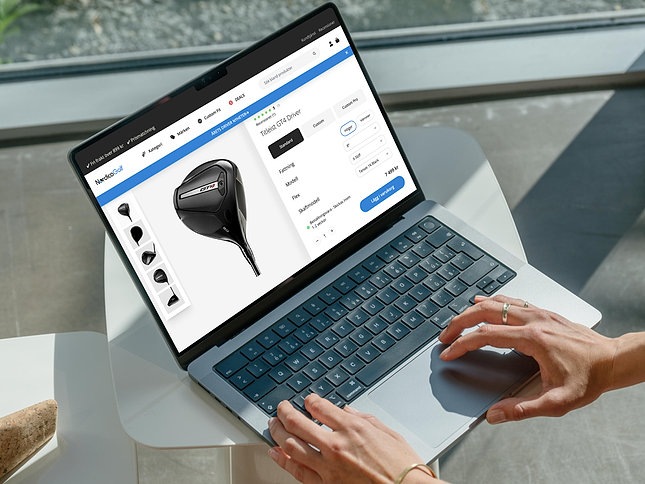
An updated product page with a focus on user-friendliness and flexibility.
At the same time, the product pages received a significant visual lift with improved color contrast, modern typography, and a more flexible layout system, where the content scales nicely on mobile, tablet, and desktop. The combination of smart UX design, powerful technology in the background, and a fast frontend solution with Fusion Storefront has resulted in both higher conversion and a more engaging purchasing experience for the end customer.
Explore NordicaGolf's product configurator.
The role of the platform – why we choose headless and Fusion Storefront
Traditional platforms can sometimes limit the flexibility of design and customization. Therefore, we have developed Fusion Storefront, our own headless frontend that provides total freedom in the interface regardless of the platform.
“The platform is of less concern to us because we use our own headless storefront. With modern CSS, we can create the design and layout we want, almost regardless of the HTML we get from the system.” explains Alexander Wassberg.
With Fusion Storefront, our customers get:
Fast load times (top performance in Core Web Vitals)
Full API integration with PIM, CMS, and payment systems
Total freedom in design and flows
UX and UI are not just a surface – they are the whole experience
User experience is not just a nice design but crucial for your sales. Thoughtful UX and UI can be the difference between a visit and a purchase, between a one-time customer and a loyal customer.
At Webbhuset, we combine strategic design, technical expertise, and a deep understanding of your target audience to create e‑commerce solutions that are not only visually appealing but also deliver results. We ensure every click feels logical, every flow is frictionless, and every visual component is rooted in user needs and behaviors.
With our technology platform Fusion Storefront, we take your e‑commerce to the next level with faster loading, higher conversion, and an engaging shopping experience.
Do you want to create an e‑commerce that both converts and impresses?
Contact us at Webbhuset and we'll explain how we can improve your customer journey with UX, UI, and Fusion Storefront.
FAQ about UX and UI
Here are some common questions and answers about UX and UI:
What does UI design mean?
UI stands for User Interface and is about how the e‑commerce looks to the user: colors, buttons, fonts, layout, and the visual interface.
What does UX design mean?
UX stands for User Experience and is about the entire user's journey: how easy it is to find, understand, add to the cart, and complete the purchase.
What is the difference between UX and UI?
UX is the experience of using the site, UI is the visual that the user sees and clicks on. Both are needed to create a seamless purchasing experience.
What does a UX/UI designer do?
A UX/UI designer creates design solutions that make it easy and clear for customers to shop. It involves both understanding the customer's needs and shaping an interface that works on all devices.
Why is UX Important for Businesses?
UX influences both sales, customer satisfaction, and brand building. In today's competitive e‑commerce world, UX can be a crucial competitive advantage. A good user experience leads to more completed purchases, happier customers, and a stronger brand. UX directly influences both sales and customer loyalty.
Book a demo with us today and we'll tell you more.
Do you want to know more?
Fill in the form and we will contact you shortly.