
It would be madness to try to guess what the future of e‑commerce will look like and then invest in something you think will last for the next five years. No one knows how the industry will look even a year from now. That's why at Webbhuset, we build and optimize to be able to change.

It would be madness to try to guess what the future of e‑commerce will look like and then invest in something you think will last for the next five years. No one knows how the industry will look even a year from now. That's why at Webbhuset, we build and optimize to be able to change.
Composable commerce: Optimized for new needs
“Ten years ago, the big challenge was to make a site responsive and adapt the design to several different screen sizes. Then came the need for a greater separation of frontend and backend, and frontend was taken out of the platform to be able to work more flexibly with the site’s design. Techniques like React and Angular began to be used. This was called headless commerce, and you could say it was a first step towards composable commerce,” explains Albert Dahlin, who is the technical manager at Webbhuset.
A development over many years
To get an overview of the development within e‑commerce, we look back ten years. At that time, all the functionality you needed was built into an e‑commerce platform such as Magento. There, you could set up price rules, handle the shopping cart, checkout, discounts, recommendations, ad spaces, and everything else you can imagine. Thousands of features existed in the same place and you only used the ones you needed.
Looking at what has happened in the world since then, the requirements have increased tremendously. It should be extremely fast and the design for e‑retailers is significantly more complex today. Discount codes sent out are unique for each individual, Google Analytics has made targeted advertising a given, email campaigns can inform you of which products you've viewed and the search function must be among the best to meet the standard.
Specialized services for each function
“For you as an e‑retailer to be competitive today, you need services that are specialized for a specific function. You might then replace the platform's own checkout with Klarna, the recommendations with Nosto, newsletter management to Klaviyo, and the product descriptions with an AI tool that writes for you. In the end, you've swapped out everything! There comes a point where the e‑commerce platform no longer adds the same value. Today, the platform is not at the center like it was ten years ago,” says Albert Dahlin.
Optimize e‑commerce for the future
The development has led to what we today call composable commerce and it is much about optimizing. Building a future-proof e‑commerce does not mean being able to peer into the future and see how the needs will look tomorrow. Instead, it’s about optimizing e‑commerce so that you can quickly and easily remove and add new functionality when the need arises.
“It would be madness to try to guess what the future of e‑commerce will look like and then invest in something you think will last for the next five years. No one knows how the industry will look even a year from now. That's why at Webbhuset, we build and optimize to be able to change. When you want to add new features and use other tools, it shouldn't require a lot of work, for me that is the essence of composable commerce,” says Albert.
High demands from visitors
The mindset within composable commerce can be applied regardless of whether you work with an e‑commerce platform like Magento or entirely without any platform. It's about building an e‑commerce that meets today's high expectations from visitors and consumers, while being able to easily change in step with the fast development we see in the industry.

With or without an e‑commerce platform
“When we know what features a customer wants in their e‑commerce, we create integrations between the various systems so that everything is connected to a site. If you want to use Magento or another platform to access parts of that functionality, we have the same mindset as if we were building without an e‑commerce platform. You could describe it as placing the e‑commerce platform to the side, and then making connections to the other systems just like we would do without a platform. Then it's easy to swap out features and make changes afterward,” says Albert.
With or without an e‑commerce platform
“When we know what features a customer wants in their e‑commerce, we create integrations between the various systems so that everything is connected to a site. If you want to use Magento or another platform to access parts of that functionality, we have the same mindset as if we were building without an e‑commerce platform. You could describe it as placing the e‑commerce platform to the side, and then making connections to the other systems just like we would do without a platform. Then it's easy to swap out features and make changes afterward,” says Albert.
Albert explains that he sees the working method as different levels. The first level and the opposite of composable commerce is to put all your functionality in the same system. The second level, he explains as placing certain functions outside your platform to disconnect and replace them. At the third level, everything is 100% optimized in a modular structure to make changes easily, and according to Albert, this is the only fitting description of composable commerce.
For both larger and smaller merchants
The benefits of composable commerce are great whether you run a large or small company. An example of how it could look for a smaller e‑commerce with a few products is to collect product data in an Excel file. In the same way as with an ERP system, the Excel file would be integrated so that information is automatically fetched to the e‑commerce from the file, and when the company has grown and wants to switch to an ERP system, it is easy to solve. The philosophy around composable commerce is not to make it more complicated than it needs to be.
“Composable commerce also works great in really large organizations. With this mindset, you can build a new e‑commerce without thousands of employees needing to learn new systems. Instead, you build the site based on the tools that the employees are already used to. Let's say the photo studio names all images with item numbers and saves them in Dropbox, copywriters collect texts in several different languages in another tool, and the purchasing department works with pricing in a third. Then we put together a site from that,” says Albert.
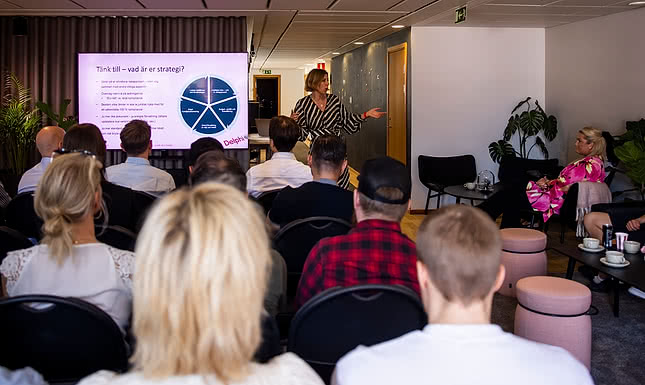

E‑commerce Meetup is one of Webbhuset's forums where you can access more information about, among other things, composable commerce and other current trends in the industry.
Challenging the philosophy
What is important when you start building an e‑commerce is what features are needed right now. Once you have a site that allows for quick changes, you can focus on learning what is successful in your particular e‑commerce and how you can sell more. “Composable commerce is just a way of thinking, it is a philosophy that we at Webbhuset have the task of constantly challenging. For you as an e‑retailer, it’s always about what you do on your site and learning how to sell more successfully,” concludes Albert.
Do you want to know more?
Fill in the form and we will contact you shortly.